On September 8, 2026, Marathon's City Council took up Resolution 2026-77. It ranks applications for the city's Residential Building Permit Allocation System for the period running from July 14, 2026 to January 13, 2027. The staff recommendation was two market-rate awards. The ranked list behind it held 52 market-rate general applications, and several of them were entered in 2004.
In Marathon, a vacant lot and the right to build a home on it are two separate assets. A buyer who pays for the first may be waiting years for the second.
Two Awards, Fifty-Two Applications
The Period 2 resolution splits the available allocations into pools. Here is how each pool came out:
| Pool, Period 2 of 2026 | Available | Recommended | What happens to the rest |
|---|---|---|---|
| Market Rate General | 2 | 2 | Nothing left over |
| Market Rate Owner Occupied | 3 | 0 | Rolls to Administrative Relief |
| Affordable General | 1 | 0 | 1 remaining |
| Community Workforce | 1 | 0 | 1 remaining |
Applicants who don't win an award keep their place in the ranking and are marked deferred. So the list is a standing queue. It doesn't reset each period, and each new application joins behind decades of earlier ones.
The ceiling on the whole system is also low. Under Marathon's agreement with the state and Monroe County, the city can issue up to 30 residential awards a year: 80% market-rate and 20% affordable. The city's BPAS page lists a smaller working schedule for even years like 2026: 9 market-rate and 3 affordable allocations, 12 in all.
Points Set the Order, Not Seniority
A lot that has waited longest isn't next in line. Staff score each application under Section 107.09 of the city's Land Development Regulations, rank by total points, and use the date and time of entry only to break ties.
The September list shows what that means in practice. The two top-ranked applications each scored 73 points and were entered in 2021 and 2022. Applications entered in 2004 sit further down, with scores of 71, 67 and 54. One application entered in May 2026 already ranks ahead of more than a dozen older ones.
For a buyer, a lot's place in this system is a score, and waiting longer doesn't promise anything. Two lots on the same street can carry very different odds of ever getting an award. A listing price rarely shows which kind of lot it is.
The State's New Units Raised the Ceiling. The Line Barely Moved.
In 2025 it looked like the logjam might break. Senate Bill 180, signed June 26, 2025, raised the Keys' hurricane evacuation standard from 24 to 24.5 hours. That created room for up to 900 new building rights over at least 10 years, and Keys Weekly reported it was the first significant addition to Keys building rights since 2012. The Marathon resolution quotes the operative language from Chapter 2025-190, Laws of Florida:
"All permits must be issued to vacant, buildable parcels, of which only one may be awarded for any individual parcel, and the distribution of which must prioritize allocations for owner-occupied residences, affordable housing, and workforce housing."
On December 17, 2025, the governor and Cabinet, sitting as the Administration Commission, divided the 900 among the Keys governments. Marathon received 135 over the decade. Islamorada got 72, Key West 36 and unincorporated Monroe County 657. A first statewide batch of 300 became available January 1, 2026, and 150 more follow every two years through 2035, according to Keys Weekly. The February 24, 2026 council minutes confirm that one-third of Marathon's 135 opened on January 1. The same night, council voted 5-0 for Resolution 2026-17, which revised the city's annual BPAS quantities and the rules for rolling unused units forward.
The city records reviewed for this post don't spell out how those 45 units move through each BPAS period. What they do show is the September result: two market-rate awards.
The new law also has a structural limit. Because it allows one right per parcel, Keys Weekly noted that it calls into question duplexes and multifamily affordable projects. It also reported that the state counts 1,610 eligible parcels across the Keys and local governments count about 1,700. Marathon's 135 arrive in installments through 2035, while the September list already holds 52 market-rate applications.
The Pool With No Applicants
The most revealing line in the table is the owner-occupied pool. It had three market-rate allocations available this period, no applications listed, and none awarded. Meanwhile, the general pool had 52 applications competing for two slots.
The rules decide where those empty slots end up. Under a state rule the Administration Commission adopted in 2011, unused market-rate allocations can only go to Administrative Relief. They don't roll forward into the next market-rate round. So in Period 2, the shortest line in Marathon's system belonged to applicants planning to live in the home they build, and nobody stood in it. SB 180's priority for owner-occupied homes, together with the city's separate pool for them, makes how a buyer plans to use a lot relevant to how its application is sorted. The September documents don't say how future periods will fill.
A House Already Carries Its Right
The other side of the market works under different rules. Marathon's Land Development Regulations exempt additions, remodeling, demolition and reconstruction of existing dwelling units from BPAS restrictions. A separate section recognizes one dwelling-unit density right for lawfully established residential units that existed in 1996 or later, and allows those units to be rebuilt subject to the rest of the code. Duplexes and multifamily structures are expressly excluded from that provision. For a nonconforming building damaged in a storm, the code generally allows restoration if work begins within one year and is diligently completed.
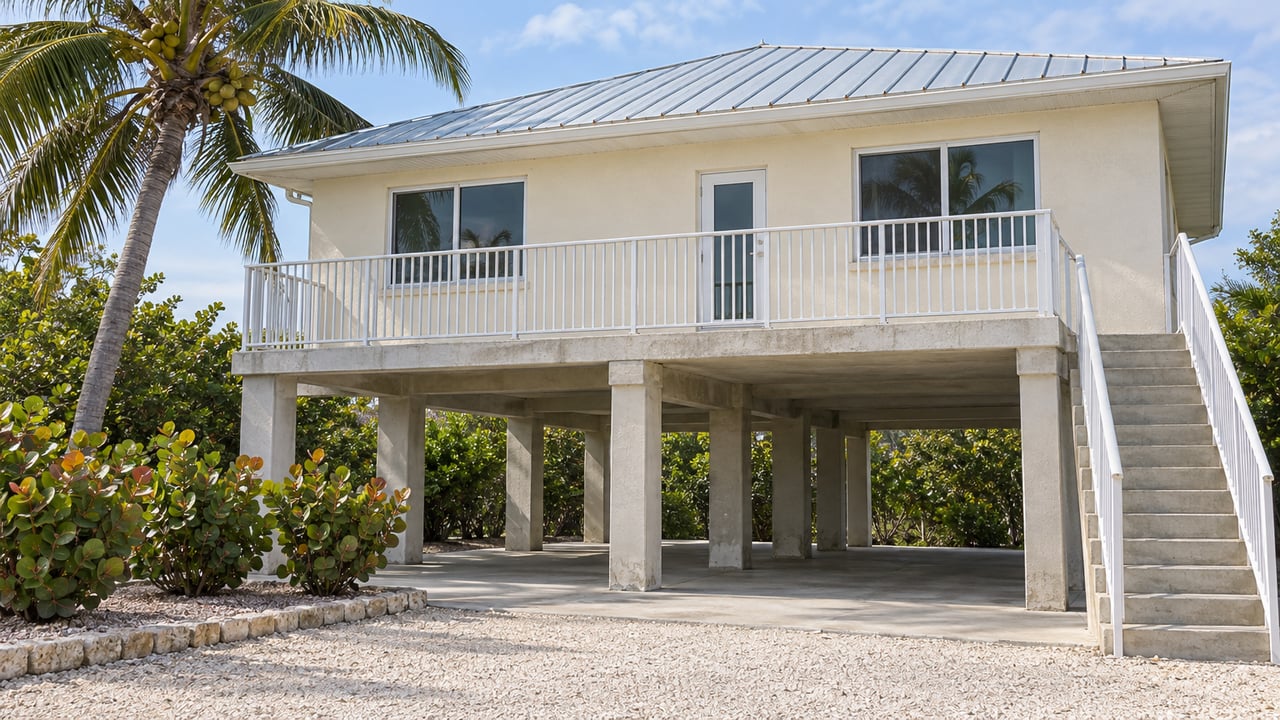
That is why a tired single-family house on a canal can be worth more than a clean vacant lot nearby. The house brings its building right with it, while the lot's owner may still be waiting on a ranked application or have yet to file one.
Three Ways a Lot Gets a Home on It
For a vacant parcel, the code and the city's resolutions describe three routes:
- A BPAS award. The application is scored, ranked and either awarded or deferred twice a year, as described above.
- A transferable building right. Under Sections 107.13 through 107.15, a lawfully established dwelling, transient-unit or commercial right can move from a sending site to a receiving site. The city must approve the transfer. The receiving site has to be appropriately zoned and no more environmentally sensitive than the sending site, and a transfer deed must be recorded. Transferring a market-rate dwelling right also triggers an affordable-housing contribution under Section 107.18. That can take the form of partial affordable-unit replacement, a cash payment, a land donation or another city-approved alternative.
- Administrative relief. When reviewing a relief request, council may offer to buy the property at fair market value, which is its preferred action for environmentally sensitive land. For other buildable properties, it may grant an award in a later period or spread one over several periods.
The legal backdrop is the cost of saying no forever. Keys Weekly reported that the stated purpose of raising the evacuation time was to head off costly lawsuits from owners of vacant lots who would otherwise be denied permits. The one recent case that went the distance involved Shands Key, a 7.9-acre offshore island. After the U.S. Supreme Court declined to hear it on June 8, 2026, Keys Weekly reported that the question of compensation was still unresolved. That case concerns an island, not a typical residential lot, so it says little about how an ordinary parcel's application would be handled.
Reading a Lot Listing in Marathon
All of this changes what a lot's asking price represents. A Marathon parcel's value depends heavily on where its building right stands. Some questions that come up in due diligence:
- Does the parcel already have a BPAS application on file, and where did it rank in the most recent period?
- Was the application filed under the general pool, the owner-occupied pool or an affordable pool?
- Is there an existing lawful dwelling unit on the site, or was there one, and does it fall under the post-1996 single-family provision?
- Would a transferable building right be possible, and would the receiving-site criteria fit this parcel?
- Does the parcel's environmental character make an Administrative Relief purchase offer more likely than a future award?
City ranking resolutions are public, and each lists applications by real estate number, so a parcel's position can be checked against the record. How any of these answers apply to a particular property is a question for the city's Planning Department and a land-use attorney.
If you're weighing a Marathon lot against an existing home, I'm glad to go through the latest BPAS ranking with you and look at where a specific parcel stands before you make an offer. Jennifer Hamill works in the Middle Keys full time, and these city records are part of how we price land here. Let's Connect.
This article is general information, not legal, tax or financial advice. Consult a qualified professional about your situation.